
Why estimates fail — and how a provable imprint check works. With an anonymised example from a real analysis.

17 June 2026 · updated 5 August 2026 · 9 min read · Methodology · Scoutvo
Scoutvo is a product brand of Tectonix LLC. We build competitive intelligence for amazon.de — with one guiding principle: clarity beats completeness.
Who sells against you determines how you have to sell. Sellers from the Far East calculate different margins, react differently to price pressure and scale ranges along different patterns than a European manufacturer. As long as you don't know who stands behind the listings in your category, you are optimising blind.
Three decisions hang on it. First, pricing: against a direct importer without intermediaries you rarely win a price war — against a European reseller with a similar cost base you might. Second, listing arguments: where competitors show neither warranty nor reachable service, that is precisely your selling point — otherwise you are giving it away. Third, range planning: a category where ten interchangeable sellers list the same factory item behaves nothing like a brand-led one.
Most tools estimate origin from brand names or shipping location. Both are worthless: a European-sounding brand name is disguise number one, and "Fulfilled by Amazon" says nothing at all about the seller — in the FBA warehouse, goods from Shenzhen sit next to goods from Solingen. The result is competitive analysis that misses exactly the sellers creating the most price pressure.
There is a second, subtler error: many analyses infer the seller from the brand. That breaks as soon as several merchants share one listing. What matters is who holds the Buy Box — because that seller makes the revenue and sets the price you are competing against.
The blanket assumption "Amazon is full of Chinese sellers" is about as useful as its opposite. How strongly a category is actually affected varies dramatically — here are two analyses from our own work, same method, two results:
In one niche, more than every second competitor was a seller from China — two of them appearing as German companies. In the other, Chinese origin sits at the margin with 18 %, and the volume leaders are established manufacturers. Anyone arguing "Made in Germany" against supposed budget sellers in the second category is fighting a ghost — and losing to Ninja and Philips.
That is exactly why origin is not a matter of opinion. It is a matter of measurement.
Step four is the one that makes the difference: every classification carries its confidence with it. A seller with a complete imprint, a German VAT ID and a commercial register entry is not the same as one where only the address looks Western. We don't claim the same thing in both cases.
A home-appliance category from a client analysis, anonymised: 16 Buy Box sellers behind the top listings.
9 of 16 sellers were based in China. 2 more appeared as German companies — address and VAT signals pointed to Shenzhen. Visibly German-run: 4. Put differently: more than every second competitor was not what they appeared to be.
Origin alone is not yet a recommendation. It becomes one when it sits next to price, rating and review mass. From the sample report, the volume leaders of that same air-fryer category:
| Competitor | Origin | Price | Reviews |
|---|---|---|---|
| Ninja FlexDrawer (10.4 L, dual zone) | US / UK | €194.99 | 4.7 ★ · 9,729 |
| Ninja Foodi MAX (9.5 L, dual zone) | US / UK | €191.30 | 4.7 ★ · 8,081 |
| Ninja Double Stack (9.5 L) | US / UK | €199.43 | 4.6 ★ · 6,201 |
| Russell Hobbs SatisFry 8.3 L (analysed) | UK | €70.00 | 4.5 ★ · 2,538 |
The picture is unambiguous: the top of this category is brand-led, expensive and fortified with review mass. The analysed product sits at €70 against €191–199 — and at 2,538 reviews against 6,000 to 9,700. The lever here is not price but visibility: whoever already leads on price has to make sure they get found. Had the category been occupied by interchangeable direct importers instead, the recommendation would be the opposite.
So it is clear what you get — and what you don't:
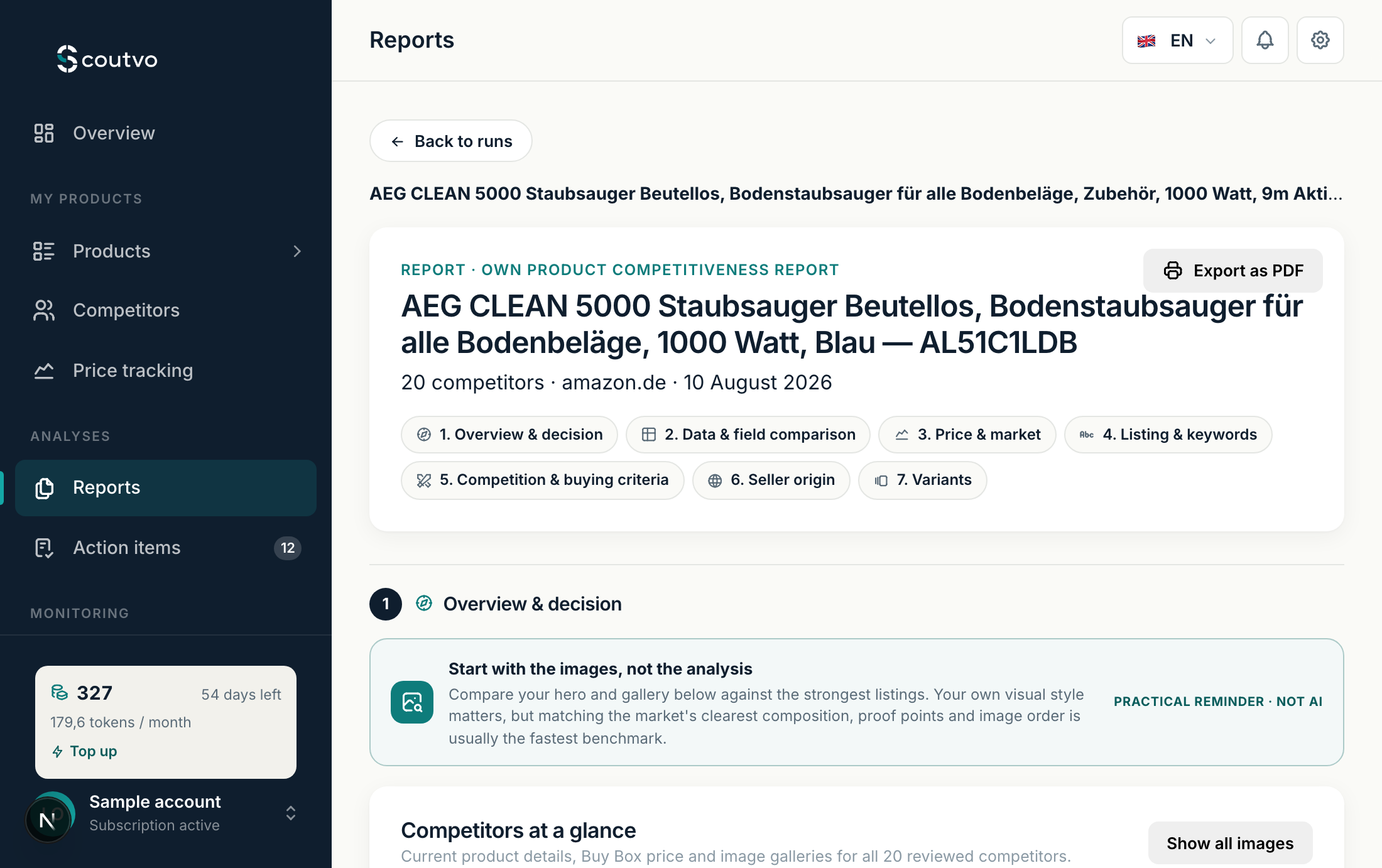
Individual cases anyone can check by hand. At 50, 100 or 200 competitors you need a system — which is exactly what we built Scoutvo for. Origin is one chapter of seven there; it sits next to price, keywords and purchase criteria in the same report:
Background on the terms in the glossary, the full methodology including confidence values on the methodology page.
With real Amazon data, Scoutvo shows you who really sells in your category, which purchase criteria matter and where your listing leaves revenue on the table — proven, not guessed.
Request a free analysis